




Best Practices of The District Courts
Best practices of the District Court
DISHA- Empowering District Courts with Smart & Paperless Reporting)
In keeping with its vision of administrative excellence, institutional efficiency, and digital modernization, Allahabad High Court has long recognized the critical importance of timely, accurate, and comprehensive reporting from the District Judiciary. Such reports form the very foundation of informed decision-making at the highest levels of judicial administration.
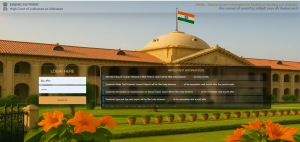
Traditionally, the process of obtaining reports from the District Judiciary relied upon manual compilation or email-based communication. While functional, this approach was often time-consuming, prone to delays, and marked by inconsistencies, thereby limiting efficiency, standardization, and real-time administrative oversight. This reality underscored the pressing need for a centralized, streamlined, and technology-driven reporting mechanism.
Recognizing this necessity, office of Central Project Coordinator (CPC), under the guidance of Hon’ble Information Technology/Computerization Committee, has conceptualized and developed the DISHA Portal – District-Courts’ Information for Statistical Handling and Analytics.
The DISHA Portal has been meticulously designed to channelize and systematize the reporting processes of District Judiciary, ensuring structure, uniformity, and operational excellence. At present, the Portal facilitates the generation and monitoring of over 100 categories of reports, covering:
-
Weekly reports
-
Monthly reports
-
Quarterly reports
-
Half-yearly reports
By transitioning from conventional, paper-based and fragmented reporting mechanisms to a centralized digital platform, the DISHA Portal delivers transformative benefits, including:
-
Real-time access to standardized reports, enabling swift and informed administrative decisions.
-
Significant reduction in manual intervention, minimizing human error and delays.
-
Elimination of duplication of work, ensuring efficiency and consistency.
-
Enhanced data accuracy and reliability, strengthening institutional confidence.
The adoption of the DISHA Portal marks a decisive leap towards:
-
Greater efficiency, transparency, and timeliness in judicial administration.
-
A paperless and environmentally sustainable working environment.
-
A future-ready administrative ecosystem, aligned with the evolving needs of governance.
Today, the DISHA Portal stands as a cornerstone of the Allahabad High Court’s digital transformation, embodying its steadfast commitment to innovation and excellence.
It is in furtherance of this visionary pursuit that the Allahabad High Court proudly Inaugurates the DISHA Portal, marking a significant milestone in the journey towards technology-enabled, modern, and responsive judicial governance.
Digital Display Board for District Judiciary (Pilot Project-District Court, Varanasi)
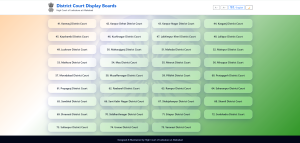
Traditionally, access to case information in district judiciary was confined to LAN-based systems and internal display boards, limiting visibility for litigants and advocates outside the courtrooms.
To provide real-time access to court proceedings and to advance Allahabad High Court’s vision of delivering citizen-centric services efficiently and without additional cost to the public, a Digital Display Board Pilot Project has been launched at the District Court, Varanasi, under the guidance of Hon’ble Information Technology/Computerization Committee. The initiative not only broadens citizen-centric services but also furthers the green initiative by promoting digital court processes.
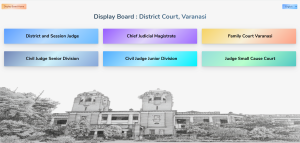
The Digital Display Board, developed under the pilot project, provides real-time case information through a centralized portal, accessible both within and beyond the court premises. This innovation facilitates timely attendance of litigants and advocates, improves punctuality, minimizes unnecessary delays, and enhances the overall transparency, efficiency, and accessibility to real-time information indicating the case number presently under consideration by the Court.
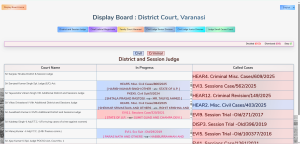
The pilot project will be carefully monitored in District Court Varanasi, and based on its success, the system will be gradually rolled out to all District Courts across Uttar Pradesh, one by one.
The Digital Display Board offers several key benefits:
-
-
Transparency: Real-time information indicating the case number presently under consideration by the Court, for the benefit of the public, litigants, and advocates.
-
Efficiency: Saves time for all stakeholders, helping them plan their schedules and attend hearings punctually.
-
Accessibility: Case information is no longer confined to internal LAN: it is available on the portal for wider access.
-
Scalability: The system can be extended to all District Courts in a phased manner based on pilot results.
-
The Digital Display Board reflects Allahabad High Court’s forward-looking adoption of technology and its commitment to enhancing administrative efficiency and pu
blic accessibility within the judicial system. By providing real-time, accurate, and relevant case information, it marks a significant step towards a more organized, transparent, and responsive court environment, thereby setting new standards for efficiency, punctuality, and innovation in judicial administration.
Click here for access Digitial Display Board
District Hardware Inventory Portal
In furtherance of its vision for transparent, accountable, and technology-driven judicial administration, Allahabad High Court has consistently emphasized the need for systematic, accurate, and real-time management of infrastructure assets across the District Judiciary. Effective governance of hardware resources is integral to ensuring operational efficiency, fiscal prudence, and uninterrupted delivery of judicial services.
Recognizing this necessity, office of Central Project Coordinator (CPC), under the guidance of Hon’ble Information Technology/Computerization Committee, has conceptualized and developed the District Hardware Inventory Portal as a comprehensive digital platform for end-to-end management of hardware assets within the District Judiciary of Uttar Pradesh.
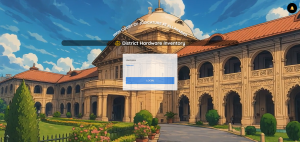
The Portal has been meticulously designed to ensure accurate inventory maintenance, serial-number-level tracking, systematic allocation, and real-time reporting of hardware assets from the High Court level down to individual courts at the district level. By enabling complete asset visibility across all tiers, the system significantly reduces manual intervention, strengthens administrative control, and promotes optimal utilization of hardware resources.
The District Hardware Inventory Portal operates on a robust, role-based access framework, ensuring accountability and data integrity at every level:
-
Super Admin (High Court level): Oversees master data and hardware catalogues, and monitors district-level records to ensure uniformity and accuracy.
-
District Admin: Functions as the district inventory custodian, responsible for recording hardware receipts, entering serial numbers, and allocating assets to various court establishments.
-
District User: Manages court-level distribution and assigns hardware to individual courts.
Key features of the Portal include:
-
Centralized and standardized inventory management
-
Comprehensive court-level and serial-number-level hardware tracking
-
Automated stock updates and real-time status monitoring
-
Generation of detailed, district-wise and court-wise reports
-
Transparent, auditable, and accountable workflows
-
Hardware optimization and lifecycle management
-
Integrated tracking of hardware maintenance and servicing
Overall, the District Hardware Inventory Portal stands as a reliable, scalable, and future-ready solution for infrastructure governance, reinforcing transparency, efficiency, and accountability in the management of judicial hardware assets. It represents a significant step in the Allahabad High Court’s ongoing journey towards technology-enabled, modern, and responsive judicial administration across the State of Uttar Pradesh.
Digital Order Sheet Module (Pilot Project- District Court, Varanasi)
In its continuing pursuit of administrative excellence, procedural uniformity, and sustainable modernization, Allahabad High Court has consistently emphasized the adoption of technology-enabled reforms to strengthen day-to-day judicial functioning. One such area identified for transformation is the preparation of daily order sheets in District Courts. Traditionally, after every hearing, routine Judicial directions such as appearance of parties, adjournments, compliance of previous orders, and fixation of next dates have been recorded through handwritten daily orders by court staff. While this long-standing practice has served its purpose, it has also revealed inherent limitations over time, including non-uniformity of records, excessive consumption of paper, and the accumulation of voluminous case files, thereby posing challenges in efficient record management and long-term preservation.
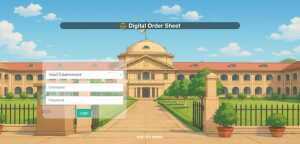
Recognizing these practical constraints, and in furtherance of the vision of Allahabad High Court, the Digital Order Sheet has been conceptualized as a facilitative, eco-friendly, and future-oriented reform of the existing manual process. The module has been developed by the Office of Central Project Co-ordinator under the guidance of Hon’ble Information Technology/Computerization Committee as a natural extension of the CIS ecosystem, without altering the judicial substance or autonomy of the Court. A key advantage of the Digital Order Sheet is its intelligent print format, wherein 8 to 10 daily orders can be accommodated on a single page. This not only significantly reduces paper consumption but also directly supports green and paper-light court initiatives. The digitally generated daily orders are print-ready and can be digitally signed, ensuring authenticity while maintaining compatibility with physical case files wherever required.
Advantages of the Digital Order Sheet:
-
Standardized Format: Ensures uniformity in the structure and phrasing of daily orders across all courts.
-
Paper Saving: Intelligent print layout accommodates 8-10 short orders per page, significantly reducing paper usage.
-
Time Efficiency: Reduces repetitive drafting effort, allowing judicial officers and staff to focus on substantive judicial work.
-
Digital Signatures: Orders can be digitally signed, ensuring authenticity and facilitating hybrid workflows (digital + physical).
The Digital Order Sheet Module stands as a testament to the Allahabad High Court’s vision of a technologically empowered, efficient, and environmentally conscious judicial administration. By ensuring structured, authentic, and optimized generation of court orders, the module enhances procedural efficiency while significantly reducing paper dependency. This initiative reinforces transparency, consistency, and sustainability, and reflects the Hon’ble Court’s steadfast commitment to innovation-driven, future-ready justice delivery.
Virtual Court Traffic integration with eChallan Traffic at Allahabad District Court
An exclusive faceless Virtual Court at Allahabad District Court is being established under the guidance of eCommittee, Supreme court of India on 23rd Feb 2021 (as a pilot project) to deal with the E-Challan generated by the Traffic Police via E-Challan application. The digital challans captured for the given day will reflect in the dashboard of the Virtual Court Judge. The court as per section of the Motor Vehicles Act will issue special summons to the violator via her/his mobile phone. Once a violator receives intimation on her/his mobile  phone, she/he would have the option to either contest the summons or pay by visiting the web portal “https://vcourts.gov.in”. She/he will pay the requisite fine through online mode on the day and the time of her/his choosing within the stipulated period. Upon payment of the fine, an acknowledgment will be generated showing the disposal of challan and the transaction number. The web portal also provides the functionality of searching the pending challans either by filling in the requisite details, viz., name, mobile number.
The autonomy given to the violator to pay a fine without having to visit a physical court will have multiple benefits not only for the individual but also for those who administer the law in terms of saving time, costs, and resources.
- This will benefit Litigants and they are not required to visit the Court for traffic-related violations.
- The revenue generated, will directly reflect in the treasury of State Government.
- This will also enhance the speedy disposal of Traffic-related Challans.
- It is also proposed that such schemes will be implemented for other nature of petty offences.
| Total eChallans received | Challans in Which proceedings completed | Contested Challans | Challans in which fine is paid | Total fine collected (INR) (01.01.2021 to Till Date) |
|---|---|---|---|---|
| 3,24,25,406 |
2,38,56,535
|
1,72,835 | 15,94,714 | 86,66,45,345 |
Integration of Civil Court Data with Land/ Property records(BHULEKH) in District Court of Uttar Pradesh
Land/ Property Records data has been one of the major reform areas wherein Land/ Property related records data needs to be integrated with all relevant agencies data including Civil Court 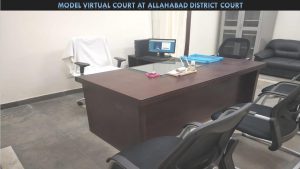 Case data so that any land/ property buyer can find out records of ownership and encumbrances at one click. With the objective of accelerating the delivery of Justice on click a reform has been initiated and integration of Court records with BHULEKH records at Court end completed now. Court user can enter the disputed property details and able to link the case. Integration with Land Record and CIS introduced and functional from 23rd Feb 2021 under the guidance of eCommittee, Supreme Court of India.
This will benefit all the Stakeholders including Lawyers, Litigants, Government authorities, Property buyers/ General Public.
eServices for Judicial Officers
A web based eservices module was developed for ensuring efficient, effective, and user friendly web based integrated System/Services with the user tracking facility for the Serving Judicial Officers posted in the State.
Recently, an Android app for the above e-Services have been developed by Office of CPC. This is first such android app for the e-Services for the Judicial Officers in the Country.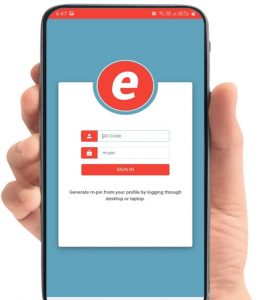
Services covered in e-Services module for Judicial Officers.
- Leave Module: Leave module containing the facility of handling different types of Leave Applications (Casual Leave, Station Leave, Earned Leave, Child Care Leave, Medical Leave, Leave encashment etc) online, which is being processed at different level and necessary approval of Hon’ble Administrative Judge/Hon’ble Judge-in-Charge is made online.
- Annual Confidential Remarks: Online filing of Self Assessment pertaining to Annual Confidential Remarks is part of the above module. The Self Assessment format for a particular assessment period shall be filled up by the concerned Judicial Officer. The ACR shall be recorded online by the District Judges/Competent Authority and is required to be submitted online.
- Property Statement: Filing of Periodic Property Statement (Movable/immovable) shall be online by the Judicial Officers, which shall be forwarded through the above e-Services. Blank Application format for filing of periodic Property Statement is available online. The Property Statement of the concerned Judicial Officer is forwarded online by the District Judge through the above e Services module.
- Other Services: A number of Other e Services (43 Numbers) are also provided in the module. These Services are Miscellaneous requests, Applications pertaining to the Higher Education, Passport/VISA or other communication with High Court by way of online Submission. Such Services are required to be made online by the Judicial Officers and necessary documents (digitally signed/Self attested) has to be attached online.
- Monitoring Mechanism of the e services: Hon’ble Administrative Judge/Judge-in-charge shall be able to view/monitor the status of the pending application on clicking the Reports section shown on left bottom side pane.
Login for e-Service of Judicial Officer
Training of Lawyers on eCourts services
In continuity to the various other training schedules regarding computerization aspect of Hon’ble High Court, an online training programme titled as “TOT Awareness Programme for Advocate Master Trainers” has been scheduled to be conducted for advocates in 05 phases, on the topic “Electronic Case Management Tools (ECMT) for the Advocates” & “Updated features of CIS” as per the directions of Hon’ble e-Committee, Supreme Court of India. This training programme is mainly aimed to prepare new “Advocate Master Trainers” who can provide further trainings to other advocates.
Schedule for Online TOT programmer for Master Trainers
-
-
- Phase-1 – ( 23.01.2021 and 24.01.2021)
- Phase-2 – (20.02.2021)
- Phase-3- (21.03.2021)
- Phase-4 – (27.08.2021)
- Phase-1 – ( 23.01.2021 and 24.01.2021)
-
Topics for Online TOT programmer for Master Trainers
-
-
- Overview of ecourts projects
- Electronic Case Management Tool for advocates
- eCourts services for mobile app for advocates
- Service delivery in Court Complexes
- eFilling- The Digital online filing process
- Virtual Courts
- Updated features of CIS 3.2 and Appeal Filing
- ICJS- Interoperable Criminal Justice Delivery System
- ECMT Tool for Commercial Courts under CIS
- How to appear in video conferencing and scan documents
- Help desk for advocates and help manual& videos
- eCourts related websites
- how to get eCourts services 24×7
- ePayment Court fees, Fine, Civil Deposits
- N-Step
- Making accessible PDF & Uploading Documents
-
- As per the directions of Hon’ble e-Committee Supreme Court of India, the complete training programme had been live streamed on YouTtube channel and the YouTube link https://youtu.be/kJb9YNeyc6c has been circulated among the Advocates of Uttar Pradesh, so that they can also be enlightened after viewing the training programme.
Website of District Courts of Uttar Pradesh
Website of District Courts of Uttar Pradesh has been developed by the Office of CPC. It is first such website dedicated for the District Courts. The website shall be visible on the Secured network only at present.
The website contains the details of eCourt projects, various publications, Circulars, Statements required by the Hon’ble High Court from time to time, District Court data for Monitoring the status.
- CMS (Complaint Management System) – The Web-based complaint management system allows the user to lodging and monitor the complaints of Hardware, Network, WAN, Software, BSNL etc. Through CMS lodged complaint information send to the concerned department and officials so that complaint resolved fastly.
- EMS (Ecourt Management System) – EMS – Ecourt Management System web-based tool to get the day to day and monthly record from District Court of Uttar Pradesh as desired by the office of CPC – Monthly SMS record, Weekly Monitoring of 25 Parameters on data cleansing, Technical Manpower record, Quarterly data of 55 parameters for information technology, Hardware installation records, etc.
- DIMS (District Inventory Management System) – DIMS is a Web-based inventory management system that allows the user to the entry of hardware details, categorization of hardware, hardware installation records, track of hardware, etc.
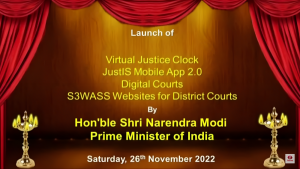
 Inauguration of Virtual Justice Clock, JustIS Mobile App 2.0, Digital Courts, and S3WASS Websites for District Courts:– The Hon’ble Prime Minister of India launched the Virtual Justice Clock, JustIS Mobile App 2.0, Digital Courts and S3WASS Websites for District Courts on 26th November 2022.
- The links for Virtual Justice Clock for the district are as follows. https://justiceclock.ecourts.gov.in/justiceClock/?p=home/state&fstate_code=13
- The Link of the S3WASS website of District Court Gautam Buddha Nagar is https://gbnagar.dcourts.gov.in/.
District Court Establishment Portal
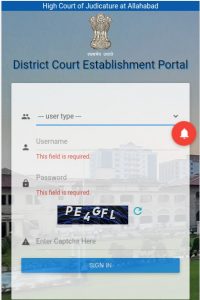
A comprehensive District Court Establishment Portal has been developed for the employees of the District Courts. The Complete details of Court staff including the sanctioned posts, vacancies, and individual service records are available on the said portal.
Click Here for District Court Establishment Portal
Inauguration of Virtual Court & EPay Portal at GautamBudha Nagar
An exclusive faceless Virtual Court at GautamBudh Nagar, District Court is being established under the guidance of eCommittee, Supreme court of India on 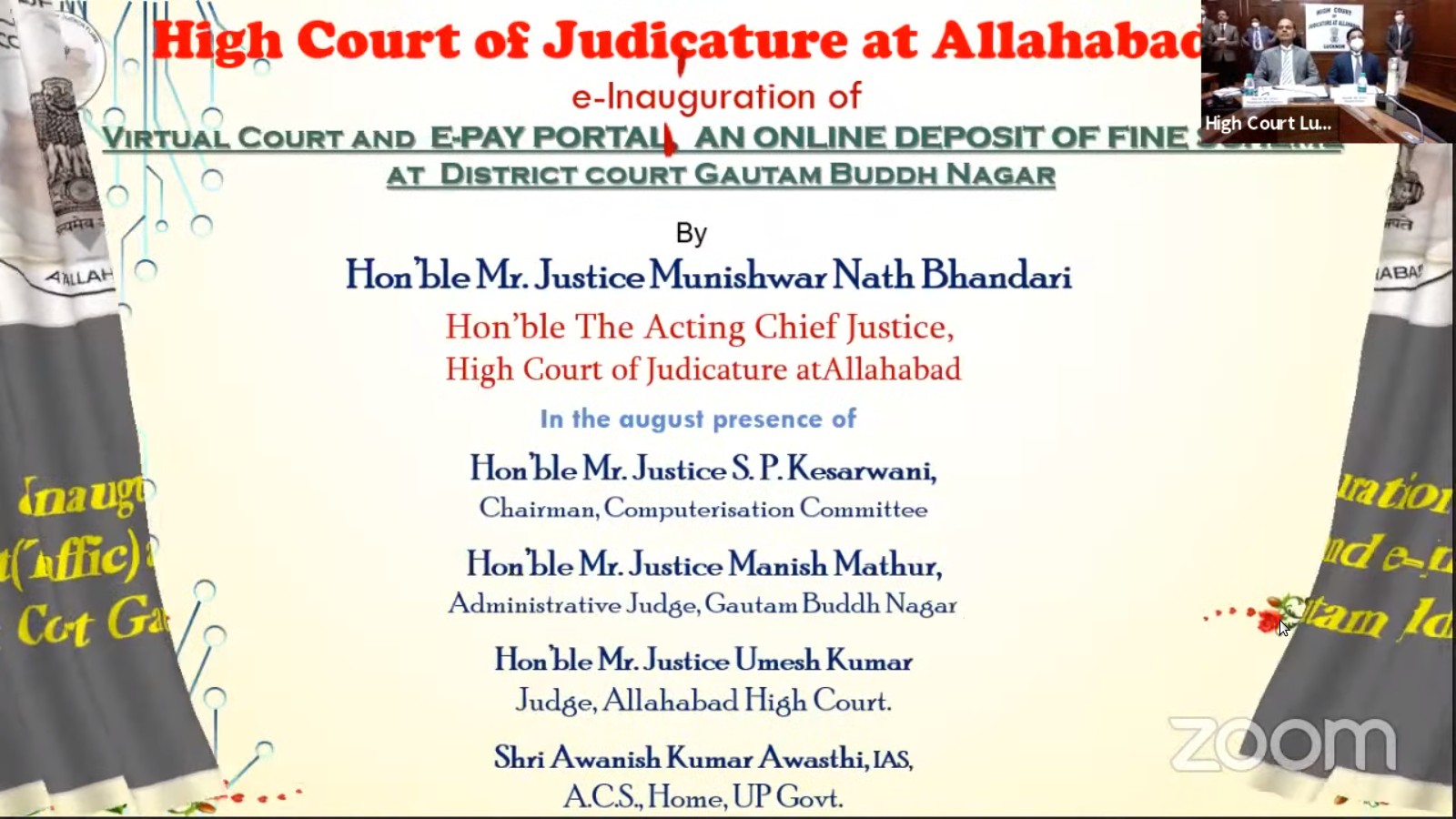 23rd July 2021 to deal with the E-Challan generated by the Traffic Police via E-Challan application. The digital challans captured for the given day will reflect in the dashboard of the Virtual Court Judge. The court as per section of the Motor Vehicles Act will issue special summons to the violator via her/his mobile phone. Once a violator receives intimation on her/his mobile phone, she/he would have the option to either contest the summons or pay by visiting the web portal “https://vcourts.gov.in”. She/he will pay the requisite fine through online mode on the day and the time of her/his choosing within the stipulated period. Upon payment of the fine, an acknowledgment will be generated showing the disposal of challan and the transaction number. The web portal also provides the functionality of searching the pending challans either by filling in the requisite details, viz., name, mobile number.
The autonomy given to the violator to pay a fine without having to visit a physical court will have multiple benefits not only for the individual but also for those who administer the law in terms of saving time, costs, and resources.
Click for View the Inauguration of Virtual Court and ePay at GautamBudha Nagar
E-payments
Online, Court Fees payment mode has been enabled for District Courts of Uttar Pradesh on ePay Portal – https://pay.ecourts.gov.in and also through Stock Holding portalhttps://www.shcilstamp.com The Court fee require to be paid in e-filed cases are also being collected through e-stamping and the e-filing portal and online payment fees system has been combined accordingly.
Through this portal now litigant/ Advocate can submit the Court fees for Old and New Cases both. After successful payment, the Court fees can be directly deposited in the State Government Head Account. Other payment options on ePay portal for Fine, Penalty and Judicial Deposits shall also be operational soon. Payment can be made through Net-banking, Debit Cards and UPI mode. Court Fees available on both the portal for 24 X 7 anytime from anywhere. Online Payment for Court Fees was inaugurated and made functional from 23.03.2021.
N-STEP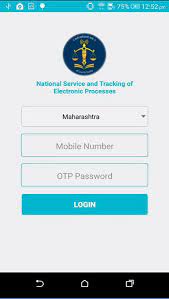
National Service and Tracking of Electronic Processes (NSTEP) is an Android OS APP developed for the service and delivery of Court Processes. This App will be used by Bailiffs of the Courts for the delivery of processes. CIS (Case Information System) software is deployed across all Courts in India. CIS provides the facility to generate electronic processes in PDF format. Once the electronic processes are generated, the process admin of the respective court will assign the delivery of processes to Bailiffs. To view a list of processes allocated to him, the Bailiff must have Smartphone with NSTEP App installed.
| Total Process/ Summon Consumed | Total Process Served |
|---|---|
| 5,66,323 (As on 18.05.2022) | 75960 (As on 18.05.2022) |
e-Inauguration of Virtual Court(Traffic) in District Court and eSewa Kendra at High Court and District Courts of Uttar Pradesh
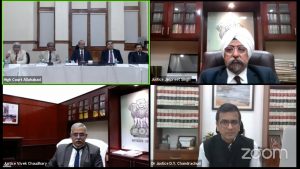


The eSewa Kendra at District Courts of Uttar Pradesh and Virtual Courts (Traffic) have been e-inaugurated by Hon’ble Dr. Justice D. Y. Chandrachud, Chairman, eCommittee, Supreme Court of India in the august presence of Hon’ble Mr. Justice Rajesh Bindal, Chief Justice, High Court of Judicature at Allahabad, Hon’ble Mr. Justice S.P. Kesarwani, Chairman, Computerization and Digitization Committee and other Hon’ble Members of the Computerization and Digitization Committee on 01st November 2021 at 04:30 pm through Virtual mode.
“e-Sewa Kendra” and “Virtual Court (Traffic)” have been a prime focus which has to be accomplished for enhancing the efficiency of Judicial system on e-Platform and accordingly, incessant efforts have been made in realizing these 02 essential e-Services to provide various facilities to the Advocates and Litigants. Through e-Sewa Kendras arrangements has been made in all the District Courts of Uttar Pradesh, from where the necessary information and assistance regarding the case details, efiling of cases, hearing details of cases, procurement of eStamps, online payments and other relevant queries can be provided through the single window.Alongwith eSewa Kendra, another important project i.e. Virtual Court (Traffic) has also been established and inaugurated in 8 (except 2 already running) vital District Courts of Uttar Pradesh namely Agra, Faizabad, Bareilly, Gorakhpur, Kanpur Nagar, Lucknow, Ghaziabad and Varanasi. The remaining District Courts of Uttar Pradesh are mapped with these 10 Virtual Courts as per their locations. By successful implementation of Virtual Courts (Traffic), the disposal of e-traffic challans can be ascertained easily and quickly through paperless mode.
The e-inauguration is available on the You Tube link : https://youtu.be/W_oG0TNQg5I
| Total e-Sewa Kendras Service used |
|---|
| 83,184 (from 21.02.2022 to Till Date) |